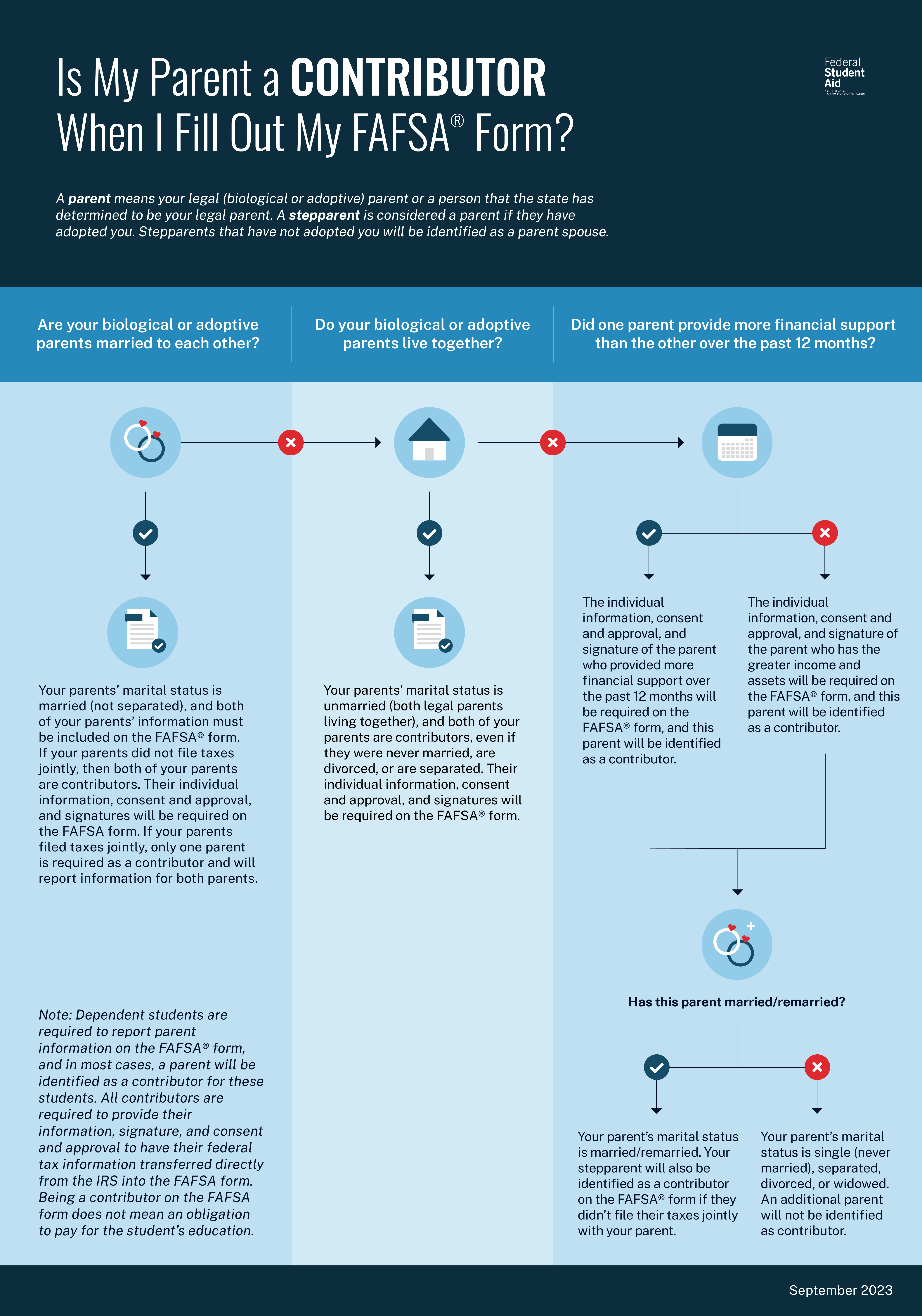

The second step is deciding whose information to include on the financial aid application. A contributor is someone who needs to provide information on the FAFSA and must give consent to allow Federal Student Aid to use their federal tax information. Consent is required even if the person did not file federal taxes.
Possible contributors include:
- The student: The student will always be required to provide their information on the FAFSA.
- The student’s biological or adoptive parent(s): For most students under age 24, their biological or adoptive parents will be contributors. If your parents are divorced or separated, you will use the parent who provided the most financial support during the past year. If parent support is split equally, the parent with the greater income and assets will be the contributor.
- The student’s stepparent: If the parent who provides more than half of the student’s financial support is remarried, the stepparent will also be required to provide information on the application.
- The student’s spouse: If the student is married, their spouse will need to provide information.
IMPORTANT
“Legal guardians”Designation by a court that authorizes someone to care for an individual in place or absence of parents. Note: legal guardians will never be contributors on FAFSA. or other relatives (aunt/uncle, grandparent, sibling) will never be contributors on the FAFSA or CASFA unless they have legally adopted the student, even if they provide most or all the financial support for the student. A “parent” on the FAFSA or CASFA is either a biological or adopted parent.
Most unmarried students under age 24 will be considered “Dependent”A dependent student is someone who must provide parent information on the FAFSA. Most students under the age of 24 are considered Dependent. for the FAFSA or CASFA, which means that they will have to include their parents’ information. However, there are exceptions. Please see these questions to help decide who will be a contributor. This tool is also very useful in helping you decide who contributors will be.
NOTE
- A student’s “Dependent” status for FAFSA/CASFA is not based on whether your parents financially support you or claim you on their taxes.
- Parent(s) who provide information on the FAFSA or CASFA don’t have to pay anything toward your education; the information is only used to assess your financial aid eligibility.
Information Needed
Contributors will provide information such as:
- Full legal name
- Social security number or permanent resident number
- Checking and savings account balances, and the amount of wages earned in 2024
- 2024 Federal Tax Return (1040 and any Schedules) for both you and your parents, if filed; or other tax returns completed by you or your parents
- 2024 W-2 and other income statements for both you and your parents, if taxes were not filed
- If you have not filed taxes, you can use information from W2s. However, if you are above the tax filing threshold, you will need to file taxes in order to receive aid. See these Tax Resources if you need help with this step.
- 2024 untaxed income records (if applicable)
- Social Security benefits statement
- Temporary Assistance for Needy Families (TANF)
- Veterans benefits records
- Disability benefits records
- Additional information (if applicable)
Watch this video to learn more about the information you’ll need to gather (the same information is needed for FAFSA or CASFA).
Gathering this information before starting the FAFSA or CASFA can help the process go more quickly and smoothly.
Step 3: Create Accounts
IMPORTANT
If you are completing CASFA, please navigate to the CASFA page to continue. Beginning at Step 3, There are important differences for FAFSA and CASFA students.
More Resources
- If your high school has a DSF Future Center, your DSF College Advisor can help you determine who your contributors are.
*available in Spanish